Businesses are always looking for ways to save time, reduce costs, and get more work done. Automation has become an important part of that effort. From sending invoices to managing customer information, businesses use automation to handle tasks that once required manual work.
Traditional automation has helped companies improve daily operations. However, as business needs become more complex, rule-based systems may not be enough. This is where AI agents come into the picture.
AI agents can understand information, make decisions, and complete tasks across different systems. But does that mean businesses should replace traditional automation with AI?
Not necessarily. Both technologies have their strengths. The right choice depends on your business processes, goals, and budget.
Let's look at how they compare and where each one makes sense.
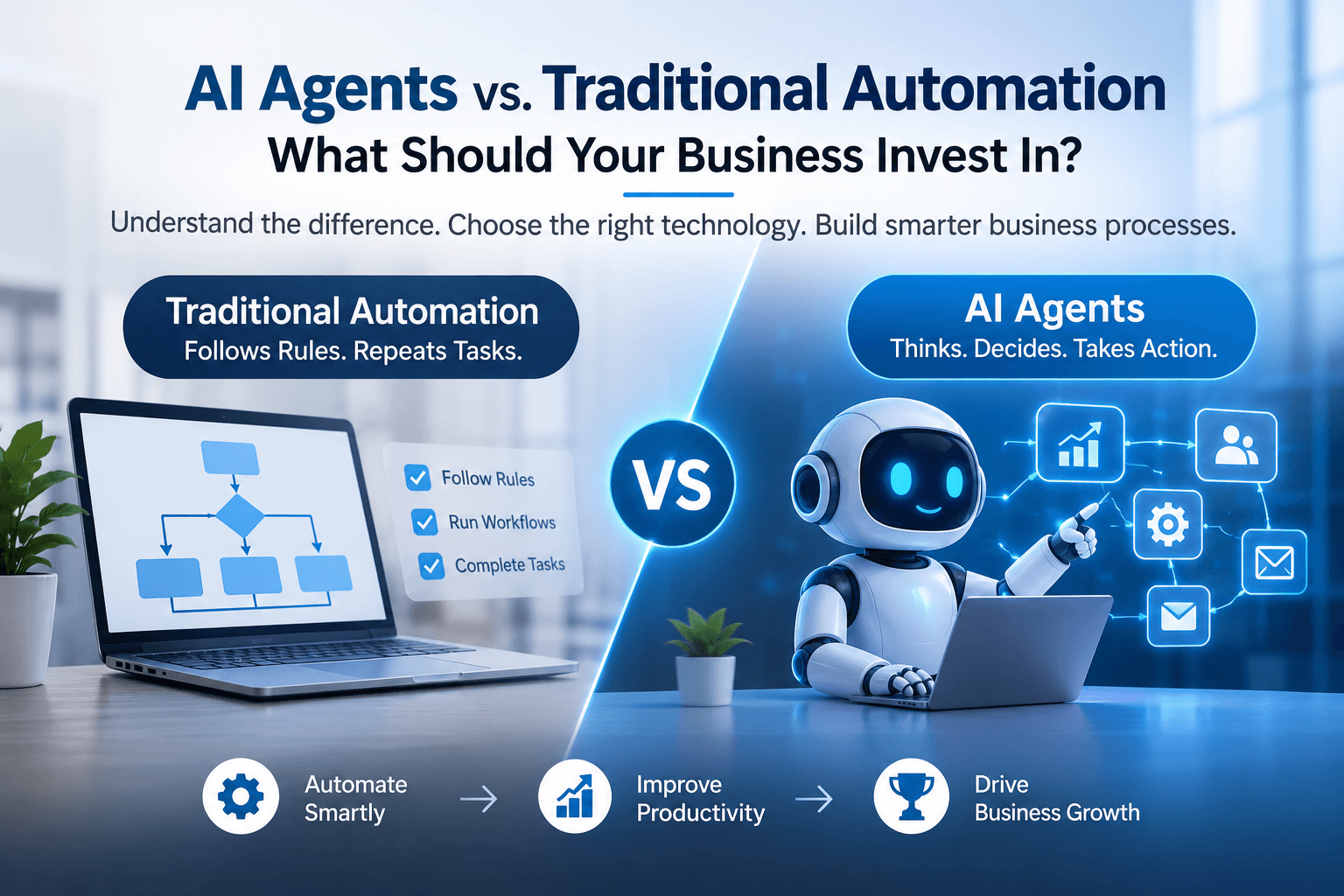
Traditional business process automation uses predefined rules to complete repetitive tasks. It follows instructions set by developers or business teams.
For example, when a customer places an order, an automated workflow can update the inventory, send an order confirmation, and notify the shipping team.
The system follows the same steps every time. It does not need to understand the situation or make independent decisions.
Common examples include automated invoice generation, appointment reminders, employee attendance tracking, CRM updates, and email notifications.
Robotic Process Automation (RPA) is another common form of traditional automation. It uses software bots to perform tasks such as copying information between applications, entering data, and processing forms.
Traditional automation works best when tasks follow clear rules and produce predictable results.
Businesses also use automation to improve wider operations. For example, read our guide on how IT services for business drive efficiency to understand how technology, cloud platforms, and workflow automation can reduce manual work.
AI agents for business use artificial intelligence to understand information, make decisions, and complete tasks based on a given goal.
Unlike traditional automation, AI agents can work with information that does not always follow a fixed format. They can understand customer messages, review documents, find relevant information, and choose the next action based on the situation.
For example, an AI customer support agent can read a customer inquiry, understand the problem, check order information, and prepare a suitable response.
An AI sales agent can review incoming leads, identify potential customers, gather relevant information, and suggest follow-up actions.
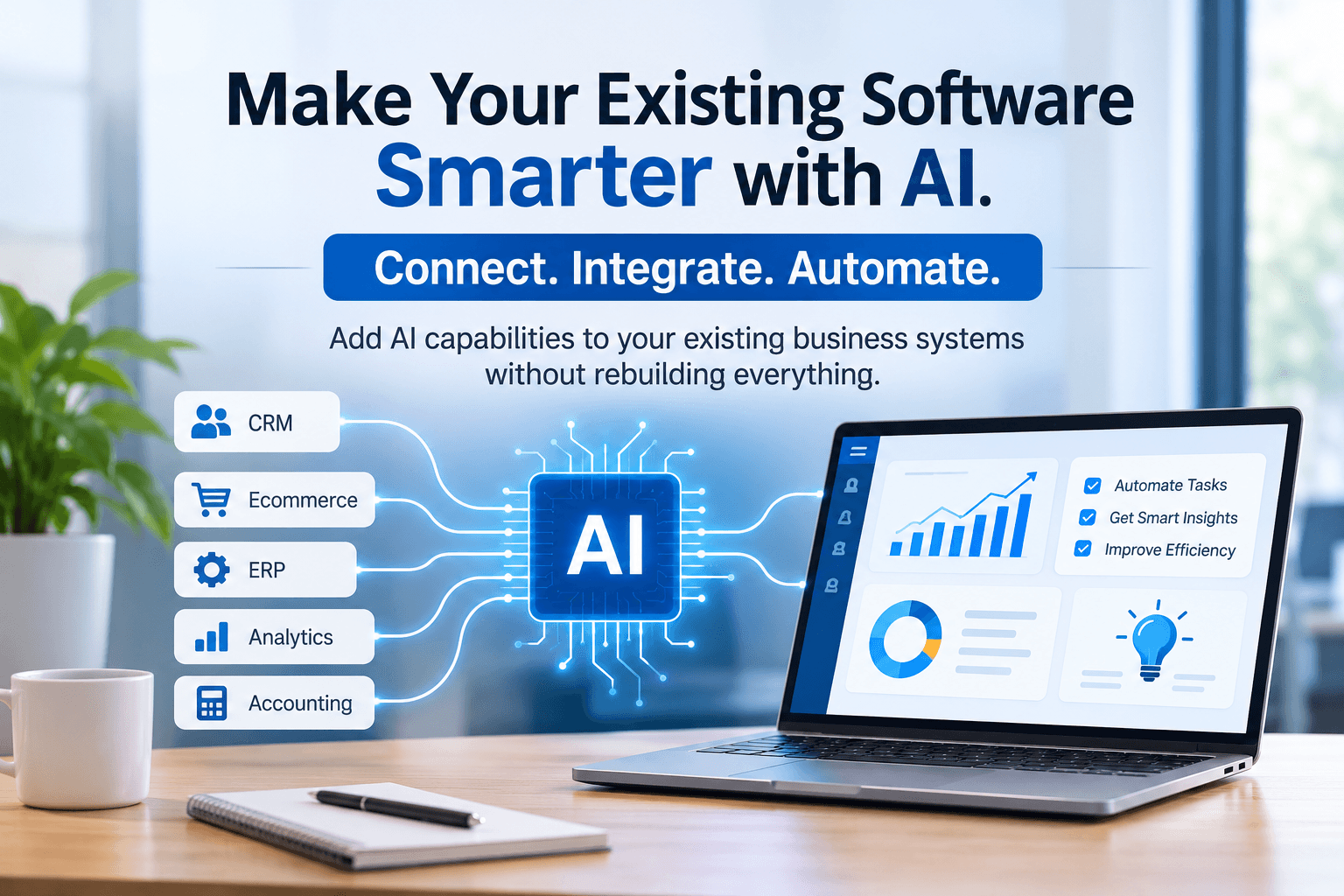
AI agents can also connect with CRM platforms, databases, APIs, and other business applications to complete multi-step tasks.
Businesses that need connected applications and centralized operations can explore Enterprise and SaaS Solutions to support their software and integration requirements.
However, AI agents' capabilities depend on the AI model, available tools, system permissions, and the quality of the information they receive. Human oversight is still important, especially when decisions involve money, customer data, or business risks.
Both technologies help businesses reduce manual work, but they approach tasks differently.
| Comparison | Traditional Automation | AI Agents |
| Working method | Follows fixed rules | Works toward defined goals |
| Decision-making | Based on predefined conditions | Uses context and available information |
| Flexibility | Limited to configured scenarios | Can handle changing inputs |
| Data handling | Best with structured data | Can process structured and unstructured data |
| Task complexity | Best for repetitive tasks | Suitable for complex, multi-step tasks |
| Exception handling | Often needs human support | Can interpret some exceptions |
| Maintenance | Requires manual rule updates | Requires model, prompt, and workflow management |
| Human involvement | Needed for unexpected situations | Needed for supervision and sensitive decisions |
The main difference is flexibility.
Traditional automation follows instructions. AI agents can interpret information and determine which action to take within their assigned limits.
This does not make AI agents the better option for every task. A simple process does not always need an AI system.
Traditional automation remains a practical investment for businesses that handle repetitive and predictable operations.
Consistent task execution: Automated workflows follow the same instructions every time, making routine processes easier to manage.
Fewer manual errors: Automating data entry, calculations, and record updates reduces mistakes caused by repetitive manual work.
Faster operations: Tasks such as invoice processing, order notifications, and report generation can run without waiting for employees to complete them.
Lower operating costs: Businesses can reduce the time employees spend on routine work and use those resources for more important activities.
Easy monitoring: Since workflows follow predefined rules, teams can track actions, identify errors, and make changes when needed.
For example, a business receiving hundreds of orders each day can use traditional automation to update inventory, generate invoices, and send order confirmations.
There is no real need for an AI agent to make decisions at every step of this process.
Businesses can also use automation during software development and deployment. Digital Crafters offers DevOps services that include build automation, continuous integration, continuous deployment, and cloud monitoring.
AI-powered automation becomes useful when business processes require more than fixed instructions.
Here are some of its key benefits.
Better handling of complex tasks: AI agents can process information from different sources and manage workflows that involve several steps.
Improved customer support: AI agents can understand customer questions, retrieve relevant information, and provide responses based on the available data.
Smarter lead management: AI agents can review incoming leads, identify customer requirements, and help sales teams prioritize follow-ups.
Working with different types of data: Unlike traditional systems that often depend on structured inputs, AI agents can work with emails, documents, messages, and other unstructured information.
Reduced manual coordination: AI agents can connect different applications and help move information between departments.
Consider a sales team receiving inquiries through its website. A traditional workflow might send the same confirmation email to every lead.
An AI agent can go further. It can analyze the inquiry, understand what the customer needs, retrieve relevant service information, and prepare a personalized response for review.
This is where the benefits of AI agents become more noticeable.
The difference between these approaches becomes clearer when we look at everyday business processes.
Traditional workflow automation depends on fixed triggers and conditions. For example, when a customer submits a contact form, the system creates a CRM record and sends an email notification.
AI workflow automation can handle more complex situations. It can analyze the form submission, identify the customer's requirements, categorize the inquiry, and recommend the right sales representative.
Here are a few more examples:
| Business Process | Traditional Automation | AI Workflow Automation |
| Invoice management | Generate and send invoices | Review invoice details and flag possible discrepancies |
| Customer support | Send predefined responses | Understand questions and prepare relevant answers |
| Sales | Send scheduled follow-up emails | Analyze lead intent and suggest follow-up actions |
| Inventory | Update stock records | Analyze demand and recommend inventory levels |
| HR | Send interview reminders | Review applications against job requirements |
The best approach depends on the task.
Businesses should use traditional automation for predictable actions and AI agents when a workflow requires interpretation, analysis, or flexible decision-making.
Before investing in business automation solutions, companies should understand the total cost of implementation and long-term maintenance.
Traditional automation usually has predictable costs. Businesses may need to pay for software licenses, development, integrations, and ongoing support.
AI agents may involve additional expenses, including AI model usage, API calls, infrastructure, data preparation, and ongoing monitoring.
However, the initial cost should not be the only deciding factor.
Businesses should measure the return on investment (ROI) by looking at the time saved, reduction in manual errors, processing costs, customer response times, and overall productivity.
For example, automating a process that takes employees several hours every week may provide clear value. But introducing an expensive AI solution for a simple task may not produce enough additional benefit.
Businesses planning larger automation projects should also consider their infrastructure and long-term operating costs. Cloud engineering solutions can support application modernization, cloud infrastructure, security, and cost optimization.
A good automation strategy starts by identifying the problem, estimating the cost of the current process, and selecting technology that can improve the results.
AI agents offer new opportunities, but businesses should also understand their limitations.
AI systems can sometimes produce incorrect information or make decisions based on incomplete data. This can create problems when they handle customer requests, financial records, or important business operations.
Data privacy is another concern. Businesses must control what information AI agents can access and how that information is used.
Integration can also be challenging. Existing applications may need API connections, custom development, or changes to support AI workflows.
Testing is another important part of implementation. Businesses should check whether automated processes work correctly before using them in daily operations. Digital Crafters provides Quality Assurance and Automation Testing Services to help test applications, APIs, performance, and software workflows.
To manage these risks, businesses should introduce permission controls, activity logs, testing, human approval steps, and clear rules for handling sensitive tasks.
AI agents should support employees, not operate without proper supervision.
There is no single automation solution that works for every business.
Traditional automation is a good choice when tasks are repetitive, rules are clear, and the same actions need to happen every time.
AI agents are more useful when tasks involve different types of information, changing inputs, and decisions that depend on context.
For many businesses, a combination of both is the most practical approach.
For example, an ecommerce company can use traditional automation to process orders, update stock levels, and send shipping notifications. At the same time, an AI agent can help answer customer questions, identify order-related problems, and recommend suitable solutions.
This hybrid approach combines the consistency of traditional automation with the flexibility of AI.
Before choosing a solution, consider your current workflows, available budget, existing software, security requirements, and future business needs.
For a wider view of how technology supports business operations, read our article on how IT services for business drive efficiency.
Choosing the right technology is only one part of business automation. The solution must also work with your existing systems and support your daily operations.
At Digital Crafters, we focus on building software solutions around actual business requirements.
Our services include custom software development, enterprise applications, CRM integration, API development, mobile applications, and digital transformation.
Our Enterprise and SaaS Solutions help businesses plan and build applications that support their operational needs.
For development and deployment workflows, our DevOps services cover build tools, CI/CD pipelines, and continuous monitoring.
We also provide Cloud Engineering Services to support cloud infrastructure, application modernization, and security.
Whether your business needs a rule-based workflow, AI integration, or a combination of both, the first step is understanding how your current processes work.
From there, the right solution can be planned, developed, and integrated into your existing business environment.
AI agents and traditional automation are not competing solutions. They solve different types of business problems.
Traditional automation remains useful for repetitive tasks that follow clear rules. AI agents add value when workflows require information analysis, contextual understanding, and flexible decisions.
For most businesses, replacing every existing automation system with AI is unnecessary. A better approach is to identify where traditional automation works well and where AI can improve the process.
The goal is not to automate everything with the latest technology. It is to choose solutions that save time, reduce costs, and help your business grow.
Looking to improve your business operations? Connect with Digital Crafters to explore custom software and business automation solutions built around your needs.
Traditional automation follows predefined rules to complete tasks. AI agents use artificial intelligence to understand information, make decisions, and perform tasks based on specific goals.
Not always. Traditional automation works well for repetitive and predictable tasks, while AI automation is more useful for complex processes that require analysis and decision-making.
RPA uses software bots to perform repetitive tasks based on predefined instructions. AI uses technologies such as machine learning and language models to understand information, identify patterns, and support decisions.
AI agents can help manage customer inquiries, organize leads, analyze documents, support employees, and automate multi-step workflows. They can reduce manual work when implemented for the right business processes.
Yes. AI agents can connect with existing CRM platforms, databases, websites, and business applications through APIs and other integrations. The available integration options depend on the software and its technical capabilities.
The cost depends on workflow complexity, AI model usage, integrations, infrastructure, and development requirements. A small AI workflow may require less investment than a large enterprise implementation.
Not necessarily. RPA remains effective for repetitive, rule-based tasks. AI agents can handle workflows that require more flexibility. Combining both technologies can provide better results for many businesses.