JavaScript now powers more than 98% of all websites, and according to industry surveys, it has remained the most widely used programming language for over a decade. As businesses race to launch faster, more interactive digital products, full-stack JavaScript development has become the default choice for building modern web applications.
At the same time, user expectations have changed. Applications are no longer static pages—they must support real-time updates, seamless performance at scale, and consistent user experiences across devices. This rising demand has pushed developers toward architectures that can handle high traffic, rapid data exchange, and continuous feature releases without slowing down development cycles.
This is where angularjs mean development stands out. By combining MongoDB, ExpressJS, AngularJS, and NodeJS into a single JavaScript-based stack, MEAN enables teams to build complete applications from frontend to backend using one language and a unified architecture. This reduces complexity, improves development speed, and makes applications easier to scale and maintain over time.
In this guide, you’ll learn how MEAN stack architecture works, what role each component plays, and why the angularjs mean stack remains a practical choice for building scalable, real-time web applications. Whether you’re evaluating technology options or planning a new project, this article will give you a clear, technical understanding of when and why MEAN stack makes sense.
MEAN stack architecture is a full-stack JavaScript framework used to build dynamic, data-driven web applications. It allows developers to use JavaScript across the entire application—frontend, backend, server, and database—creating a consistent and efficient development workflow. This unified approach reduces friction between layers and makes applications easier to develop, scale, and maintain.
Each component in the MEAN stack plays a distinct role in the application lifecycle while working seamlessly together within the same ecosystem.
MongoDB is a NoSQL database that stores data in flexible, JSON-like documents. This structure aligns naturally with JavaScript-based applications and simplifies data exchange across the stack. MongoDB scales horizontally, making it well-suited for applications that handle large volumes of data or unpredictable traffic patterns. In a modern mongodb stack, it supports fast reads, high availability, and schema flexibility.
ExpressJS is a lightweight backend framework built on NodeJS. It handles routing, middleware, and server-side logic while keeping the application structure clean and manageable. ExpressJS simplifies API development and acts as the bridge between MongoDB and the frontend. The tight integration of expressjs angularjs allows backend services to efficiently deliver data to the user interface.
AngularJS is a frontend framework designed for building dynamic single-page applications. It uses two-way data binding to keep the UI synchronized with the underlying data model, reducing manual updates and improving user experience. Within the angularjs mean stack, AngularJS manages views, user interactions, and client-side logic, enabling faster and more responsive interfaces.
NodeJS is the server-side runtime that executes JavaScript outside the browser. It uses a non-blocking, event-driven architecture, which allows applications to handle multiple requests efficiently. NodeJS forms the backbone of the MEAN stack, supporting real-time features and high-concurrency workloads without performance bottlenecks.
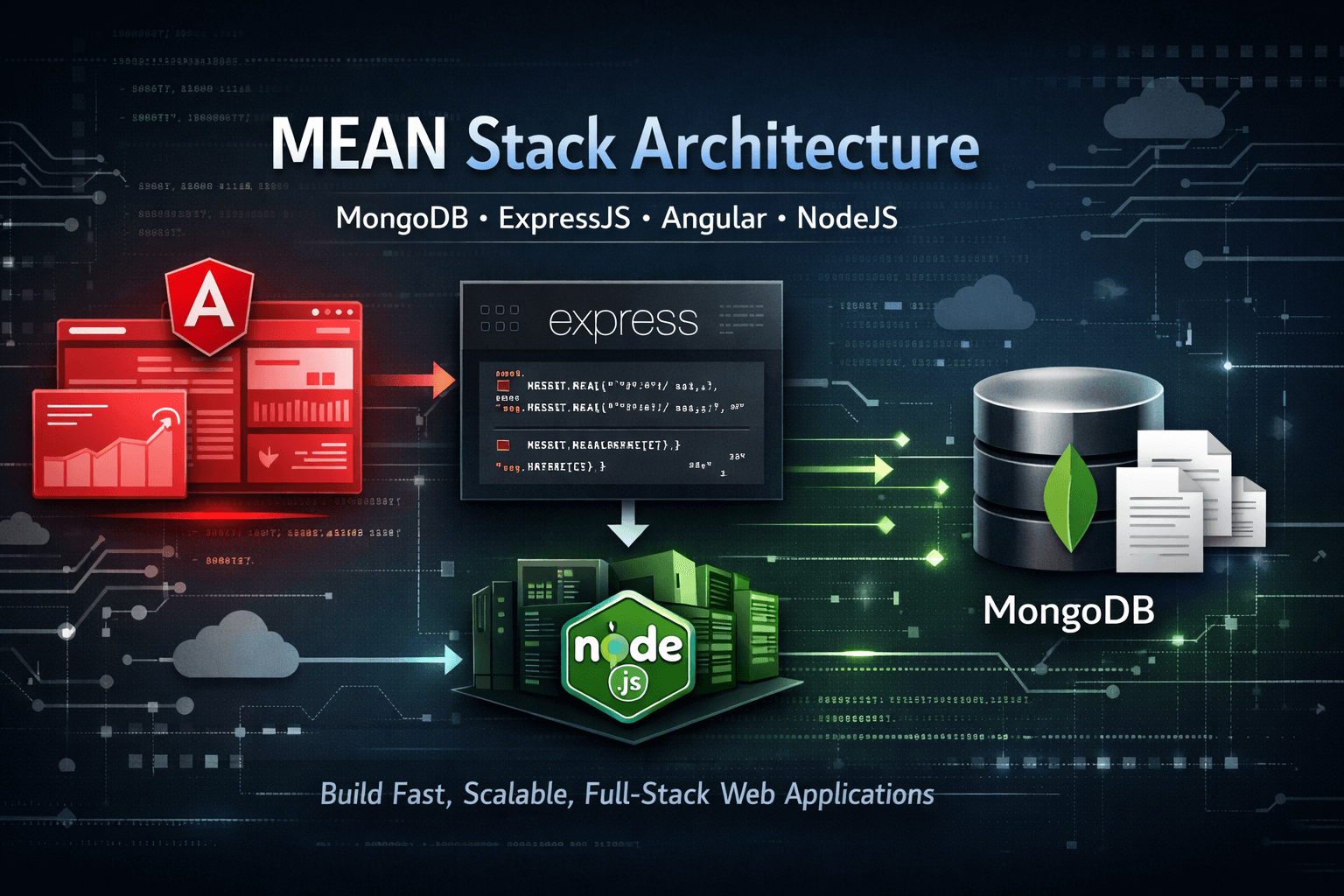
In MEAN architecture, the AngularJS frontend runs in the browser and communicates with the backend through HTTP requests. User actions trigger requests that are processed by ExpressJS and NodeJS on the server. The server retrieves or updates data in MongoDB and returns a response to the client, keeping interactions fast and consistent.
RESTful APIs are central to MEAN stack communication. ExpressJS defines API endpoints that handle requests such as data creation, retrieval, updates, and deletion. These APIs ensure a clear separation between frontend and backend while allowing both layers to evolve independently within the same mean architecture.
Data flows as JSON throughout the entire stack. AngularJS sends requests in JSON format, ExpressJS processes them, MongoDB stores data as documents, and NodeJS manages the server-side logic. This consistent data format minimizes transformation overhead and makes the angularjs mean approach efficient for building scalable, real-time web applications.
The strength of the MEAN stack lies in how each component solves a specific problem while working together within a single JavaScript ecosystem. From data storage to user interaction, every layer is designed for performance, scalability, and consistency.
MongoDB is a NoSQL database built around a document-based data model. Instead of rows and tables, it stores data in JSON-like documents, making it easier to represent complex and evolving data structures. This flexibility allows developers to adapt the data model as application requirements change, without costly migrations.
MongoDB fits naturally into a mongodb stack because its document format aligns with how data is handled in JavaScript. Objects created in the application can be stored and retrieved with minimal transformation, reducing development time and potential errors. This seamless compatibility is a key reason MongoDB is widely used in MEAN stack projects.
From a performance standpoint, MongoDB is designed for scale. It supports horizontal scaling through sharding, handles large datasets efficiently, and delivers fast read and write operations. These capabilities make it a strong choice for applications that need to grow without sacrificing reliability or speed.
ExpressJS is a backend framework that runs on top of NodeJS and simplifies server-side development. It manages routing, request handling, middleware, and API creation in a structured and lightweight way. Developers can define clear endpoints for handling client requests while keeping the backend codebase organized and easy to maintain.
ExpressJS pairs well with NodeJS because both are built around the same event-driven model. This combination allows the server to process multiple requests at once without blocking operations, which is critical for high-traffic applications. The result is a backend that remains responsive even under heavy load.
In real-world applications, expressjs angularjs integration enables smooth communication between the frontend and backend. ExpressJS exposes RESTful APIs that AngularJS consumes to display and update data in real time. This pattern is common in dashboards, SaaS platforms, and enterprise web applications where frequent data updates are required.
AngularJS is a frontend framework used to build dynamic and interactive user interfaces. One of its core features is two-way data binding, which automatically synchronizes data between the model and the view. This reduces manual DOM manipulation and helps maintain consistent application state. AngularJS also follows the MVC pattern, which keeps presentation, logic, and data handling clearly separated.
AngularJS is well suited for building single-page applications (SPAs). Instead of reloading entire pages, SPAs update content dynamically as users interact with the application. This approach improves performance and delivers a smoother user experience, especially in data-heavy applications.
Within the angularjs mean stack, AngularJS provides a structured and maintainable frontend layer. Its tight integration with RESTful APIs, reusable components, and built-in services makes UI development faster and more predictable for complex web applications.
NodeJS is the server-side runtime environment that powers the MEAN stack. It uses an event-driven, non-blocking I/O model that allows the server to handle many concurrent connections efficiently. This architecture makes NodeJS ideal for applications that require speed and responsiveness.
NodeJS is widely used to support real-time features such as live notifications, chat systems, and streaming updates. By handling asynchronous operations efficiently, it ensures that applications remain responsive even when processing multiple requests simultaneously.
As the core of the MEAN stack, NodeJS connects all components. It runs ExpressJS on the server, communicates with MongoDB for data operations, and serves APIs to the AngularJS frontend. This central role makes NodeJS the backbone that keeps the entire mean architecture working as a unified system.
The angularjs mean stack is designed to function as a tightly integrated system rather than a collection of separate tools. Each layer communicates through well-defined interfaces, allowing data to move smoothly from the user interface to the database and back. This cohesion is what makes MEAN stack development efficient and reliable for modern web applications.
In an AngularJS MEAN application, the frontend and backend communicate through API calls. When a user interacts with the interface, AngularJS sends HTTP requests to the server. These requests are handled by ExpressJS running on NodeJS, which processes the business logic and determines how to respond.
Once the request is processed, the server retrieves or updates data in MongoDB and sends a response back to the frontend. AngularJS then updates the view based on the returned data. This request–response cycle happens quickly and consistently, ensuring a responsive user experience even in data-intensive applications.
JSON acts as the standard data format across the entire MEAN architecture. AngularJS sends data as JSON, ExpressJS processes JSON payloads, and MongoDB stores data in JSON-like documents. This shared format eliminates the need for complex data conversions and reduces the chance of errors during data exchange. Using JSON throughout the stack keeps communication clean, predictable, and easy to debug.
One of the biggest advantages of the angularjs mean approach is the use of JavaScript at every layer of the application. Developers write JavaScript for the frontend, backend logic, server runtime, and database interactions. This single-language model simplifies development workflows and reduces context switching between different technologies.
Unified JavaScript development leads to faster build times and easier long-term maintenance. Teams can reuse validation logic, data models, and utility functions across the application. Onboarding new developers becomes simpler because they only need to master one primary language and a consistent development pattern. As a result, MEAN stack projects are easier to scale, update, and support over time while maintaining clean and manageable codebases.
MEAN stack architecture is widely adopted because it delivers measurable benefits across performance, development speed, and cost. By using a unified JavaScript ecosystem, it helps teams build scalable applications without adding unnecessary complexity.
MEAN stack applications are designed to handle high traffic efficiently. NodeJS uses a non-blocking, event-driven model that allows the server to process many requests at the same time without slowing down. This makes the MEAN stack well suited for applications that require real-time data updates or must support a growing number of users.
MongoDB adds to this performance advantage by supporting horizontal scaling. Instead of relying on a single server, data can be distributed across multiple nodes through sharding. This allows applications built on mean architecture to scale as demand increases while maintaining consistent performance and availability.
One of the main reasons teams choose the angularjs mean stack is speed of development. The stack promotes a modular architecture where components are reusable and easy to maintain. AngularJS enables developers to break the UI into structured components, while ExpressJS and NodeJS support clean and organized backend logic.
Using JavaScript across the entire stack reduces context switching. Developers do not need to move between different programming languages for frontend and backend tasks. This leads to fewer errors, faster debugging, and shorter development cycles, especially for teams building complex applications.
MEAN stack technologies are open source, which means there are no licensing fees or vendor lock-in costs. Businesses can allocate budgets toward development and infrastructure rather than software licenses, making MEAN a cost-effective choice for startups and enterprises alike.
In addition, the MEAN stack benefits from strong community support. Large developer communities contribute libraries, tools, and ongoing improvements. This ecosystem ensures long-term stability, regular updates, and access to shared knowledge, making the angularjs mean approach reliable for building and maintaining modern web applications.

The MEAN stack is used across industries because it supports scalability, real-time data handling, and rapid development. Its full-stack JavaScript approach makes it suitable for applications that require speed, flexibility, and long-term maintainability.
Enterprise applications often manage large datasets, complex workflows, and high user concurrency. MEAN stack architecture supports these requirements by combining NodeJS for efficient request handling and MongoDB for scalable data storage. AngularJS provides structured frontend development, making it easier to manage complex interfaces. This makes the angularjs mean stack a strong choice for internal portals, CRM systems, and enterprise management platforms.
Real-time applications depend on fast data exchange and consistent performance. NodeJS enables real-time communication through asynchronous processing, while ExpressJS manages API interactions efficiently. AngularJS updates the user interface instantly as new data arrives, creating a smooth real-time experience. These capabilities make MEAN stack ideal for chat applications, live notifications, and collaboration tools that require continuous updates.
E-commerce platforms must handle high traffic, secure transactions, and frequent data updates. MEAN stack applications can manage large product catalogs, user sessions, and order processing without performance issues. MongoDB supports flexible product data models, while AngularJS delivers responsive and interactive shopping experiences. The mean architecture also allows e-commerce platforms to scale easily during peak traffic periods.
SaaS applications rely on clean user interfaces, frequent feature updates, and reliable performance. MEAN stack enables modular development, making it easier to roll out new features without disrupting existing functionality. AngularJS works well for data-driven dashboards, while NodeJS and ExpressJS ensure stable backend services. This makes the angularjs mean approach well suited for analytics platforms, admin dashboards, and subscription-based software products.
Choosing the right technology stack depends on project requirements, team expertise, and long-term maintenance goals. Comparing MEAN with other popular stacks helps clarify where mean architecture delivers the most value.
The main difference between MEAN and MERN lies in the frontend framework. MEAN uses AngularJS, while MERN replaces it with React. AngularJS is a full-featured framework that includes built-in tools for routing, data binding, and application structure. This makes it suitable for large, structured applications that benefit from a defined architecture.
React, on the other hand, is a UI library focused on building components. It offers more flexibility but often requires additional libraries for routing and state management. Teams that prefer a complete framework with clear conventions may lean toward the angularjs mean stack, while those seeking a more flexible frontend approach may choose MERN.
MEAN is a strong choice when projects require a structured frontend, consistent patterns, and long-term maintainability. It works well for enterprise applications and large-scale platforms. MERN is often preferred for projects that prioritize UI flexibility, rapid prototyping, or highly customized interfaces. The decision depends on how much structure versus flexibility the team needs.
The LAMP stack—Linux, Apache, MySQL, and PHP or Python—has been a traditional choice for web development for many years. However, it relies on different languages across the stack, which can slow development and increase complexity. MEAN uses JavaScript end to end, allowing developers to work within a single language and shared data format.
JavaScript vs Traditional Server-Side Languages
With MEAN, JavaScript handles frontend logic, backend services, and database interactions. This reduces context switching and improves collaboration between frontend and backend teams. Traditional server-side languages in LAMP often require additional integration layers and data transformations, which can increase maintenance effort.
Flexibility and Modern Development Practices
MEAN stack supports modern development practices such as RESTful APIs, real-time communication, and modular application design. MongoDB’s flexible schema and NodeJS’s event-driven model allow applications to adapt as requirements change. Compared to LAMP, angularjs mean development offers greater flexibility, faster iteration, and a development workflow better aligned with modern web application needs.
While MEAN stack architecture offers many advantages, it also comes with challenges that teams should evaluate before adoption. Understanding these limitations helps set realistic expectations and avoid common implementation issues.
MEAN stack development requires familiarity with multiple technologies that work together as a single system. New developers must understand AngularJS for frontend logic, ExpressJS and NodeJS for backend development, and MongoDB for data storage. For beginners, learning how these components interact within mean architecture can take time, especially without prior experience in full-stack JavaScript development.
AngularJS relies on two-way data binding, which can impact performance in large or complex applications. As the number of bindings increases, change detection can become slower, particularly in views with heavy data updates. Without careful optimization, this may lead to reduced responsiveness. Teams using the angularjs mean stack often need to apply best practices such as limiting watchers, optimizing scopes, and structuring components efficiently to maintain performance.
Single-page applications built with AngularJS may face SEO challenges because content is rendered on the client side. Search engines can have difficulty indexing dynamically loaded content if server-side rendering is not implemented correctly. To address this, developers may need to use techniques such as pre-rendering or server-side rendering with NodeJS. While these solutions improve search visibility, they add complexity to angularjs mean development and require additional configuration and maintenance.
Building reliable applications with MEAN stack architecture requires more than choosing the right technologies. Clear structure, strong security, and ongoing performance optimization are essential for creating applications that scale and remain stable over time.
A scalable MEAN application starts with a clean and modular structure. Separate frontend and backend concerns while maintaining consistent data models across the stack. AngularJS components should be organized by feature rather than by file type, making the codebase easier to navigate and extend. On the backend, ExpressJS routes, controllers, and services should be clearly defined to keep logic manageable as the application grows.
Using environment-based configurations and versioned APIs also helps maintain scalability. These practices ensure that mean architecture remains flexible as new features are added or traffic increases.
Security is a critical part of any MEAN stack application. Since JavaScript runs across the entire stack, vulnerabilities in one layer can affect the whole system if not addressed properly.
Authentication and Authorization
Implement secure authentication mechanisms using industry-standard practices such as token-based authentication. JSON Web Tokens (JWTs) are commonly used in angularjs mean stack applications to manage user sessions securely. Role-based access control ensures users only access resources appropriate to their permissions.
Data Validation and Protection
All incoming data should be validated on the server side, even if client-side validation is in place. ExpressJS middleware can be used to sanitize inputs and prevent common attacks such as injection or cross-site scripting. Encrypt sensitive data and use secure communication protocols to protect information throughout the application.
Caching Strategies
Caching reduces server load and improves response times. Frequently requested data can be cached at the API or database level to avoid unnecessary processing. In MEAN stack applications, caching is especially useful for read-heavy endpoints and static resources.
Database Indexing
Proper indexing in MongoDB is essential for performance at scale. Indexes speed up query execution and reduce database load, particularly in applications with large datasets. Regularly monitoring query performance and adjusting indexes helps keep angularjs mean applications responsive as data volume grows.
Choosing the right technology stack depends on how well it aligns with your project goals, team capabilities, and long-term plans. The angularjs mean stack can be a strong fit in many scenarios, but it is not a one-size-fits-all solution.
AngularJS MEAN stack works best for medium to large applications that require structured development and clear separation of concerns. Its MVC-based frontend and modular backend architecture support complex workflows, multiple user roles, and data-heavy features. For simple or short-term projects, however, the overhead of setting up full mean architecture may outweigh its benefits. Smaller applications may not need the scalability and structure that MEAN provides.
MEAN stack development requires a solid understanding of JavaScript across the frontend, backend, and database layers. Teams with experience in AngularJS, NodeJS, and MongoDB can take full advantage of the stack’s unified language model. For teams new to full-stack JavaScript development, the learning curve may slow initial progress. In such cases, training or onboarding time should be factored into the project plan.
Long-term maintenance is a key consideration when choosing angularjs mean development. MEAN stack applications benefit from reusable code, consistent data formats, and a large open-source ecosystem. However, AngularJS requires careful planning to manage performance and future upgrades. Projects with long lifecycles should account for ongoing optimization, framework updates, and technical debt management to ensure the application remains stable and maintainable over time.
The MEAN stack has evolved alongside changes in the JavaScript ecosystem. While newer frameworks continue to emerge, MEAN remains relevant for teams that value stability, scalability, and a unified development model.
AngularJS has played a major role in shaping modern frontend development by introducing structured application architecture and two-way data binding. Although newer versions of Angular and other frameworks have gained popularity, many production applications still rely on AngularJS. Ongoing community support, long-term maintenance strategies, and enterprise use cases continue to keep AngularJS viable in existing angularjs mean stack projects. For organizations with established AngularJS codebases, maintaining and optimizing current applications often makes more sense than full rewrites.

MEAN stack continues to influence how modern JavaScript applications are built. Its emphasis on RESTful APIs, JSON-based data exchange, and full-stack JavaScript development aligns closely with current best practices. Even when teams adopt newer frontend frameworks, the backend principles of mean architecture—using NodeJS, ExpressJS, and MongoDB—remain widely applicable and relevant.
The long-term viability of MEAN stack depends on how it is used and maintained. Applications built with clean architecture, strong security practices, and performance optimization can remain stable and scalable for years. While frontend technologies may evolve, the core strengths of angularjs mean development—unified language, scalable backend, and flexible data handling—continue to support long-term application growth. For many organizations, MEAN stack remains a practical and future-ready choice when implemented thoughtfully.
Conclusion: Building Scalable Web Apps with MEAN Stack
According to recent surveys, over 70% of full-stack developers prefer JavaScript-based stacks for modern web applications, highlighting the growing demand for unified development frameworks. The MEAN stack—MongoDB, ExpressJS, AngularJS, and NodeJS—offers a comprehensive solution for building scalable, high-performance applications that can handle real-time data and evolving business requirements.
By combining a flexible NoSQL database, a lightweight backend framework, a dynamic frontend library, and a fast server runtime, MEAN stack simplifies development while maintaining consistent performance across all layers. Its modular architecture, reusable components, and unified JavaScript approach reduce development time, improve maintainability, and support long-term scalability.
For organizations seeking a reliable full-stack solution, the angularjs mean stack remains a strong choice. Whether you are building enterprise portals, real-time applications, e-commerce platforms, or SaaS dashboards, MEAN stack provides the tools and ecosystem to deliver robust, maintainable, and high-performing web applications. Exploring MEAN stack development today can set the foundation for faster, more efficient, and future-ready web solutions.